 Tokyo Photoshoot
Portrait Photography Workshop with a Model
Every other listing on this site sells you a photographer. A Tokyo photography workshop sells you the opposite arrangement: LensTokyo charges $50 per person, reduced from $62, for 1.5 hours in which you hold the camera and a hired local freelance model poses for you, with an instructor watching over your shoulder and correcting what you do. The group is capped at two students. You meet at the Hachiko statue in Shibuya. And you have to bring a DSLR, mirrorless or film camera, because a phone is not the tool this session is built around.
About This Tokyo Photography Workshop
1.5 hours. Start times appear at checkout
$50 per person, reduced from $62, read from the listing in August 2026
None yet. This is a new activity with no reviews, which the listing states itself
Your own photographs, on your own memory card. Nothing is delivered to you afterwards because nothing is shot by anyone else
Tokyo's well-known landmarks and lesser-known spots, starting at the Hachiko statue in Shibuya
Travellers who own a camera and want to come home better at using it, from complete beginners upwards
Listing at a Glance
The same fields on every session page here, read off the operator's listing in August 2026. Prices, slots and inclusions are set by the operator and confirmed at checkout on the booking platform.
- Session name Tokyo: Portrait Photography Workshop with Model
- Operator LensTokyo
- Product ID 1429348
- Starting price $50 USD per person, reduced from $62
- Price last checked August 2026
- Rating None. Listed as a new activity
- Review count No reviews yet
- Duration 1.5 hours
- Format Instructor-led workshop. You photograph a model; nobody photographs you
- Group size Small group, limited to 2 participants
- Languages English and Japanese
- Model A local freelance model, hired for the session. The listing notes the model may sometimes be Japanese
- Camera required Bring a DSLR, mirrorless or film camera
- Also bring Comfortable shoes and a charged smartphone
- Flash Off-camera flash practice is included and you do not need to own a flash to join
- Syllabus Camera settings, composition, working with light, preparing for a shoot, running a session, and English phrases for giving posing directions
- Feedback Individual feedback from the instructor throughout the session
- Experience needed None. Beginners are welcome, and the workshop encourages questions and interaction
- Meeting point Directly in front of the Hachiko statue, Shibuya
- Transportation fees Not included
- Food and drinks Not included
- Photos delivered None. You keep the files you shoot yourself
- Model release None stated. Ask the instructor before publishing pictures of the model commercially
- Cancellation deadline Free cancellation up to 24 hours before the session
- Reserve now, pay later Available. Book the slot and pay nothing today
- Minimum age None stated
- Difficulty Easy on foot. The demand is on attention rather than fitness
- Wheelchair accessibility None stated
- Weather policy None stated
- Alternative session If you would rather be photographed in the same district, /shibuya-neon-photo-tour/
Check Dates and Availability
Live start times and prices from the booking platform, with free cancellation up to 24 hours before the session.
Quick answer What ninety minutes with a model teaches, and the kit you cannot turn up without
Ninety minutes at $50 per person in which you are the photographer. An instructor covers camera settings, composition and light, then a hired local freelance model poses for you on location while you get individual feedback on what you are doing. The group is limited to 2 participants, teaching runs in English and Japanese, and off-camera flash is practised with equipment you do not have to own. You must bring a DSLR, mirrorless or film camera. It is a new activity with no reviews yet.
Key takeaways
- Bring a real camera. The portrait workshop lists a phone under what to bring, but a DSLR, mirrorless or film body is the requirement
- Two students maximum means the feedback is genuinely individual, which is rare at this price
- If you actually wanted to be in the pictures, the short session at Shibuya Crossing is fifteen to forty-five minutes at the same landmark
- For a full hour of being photographed in the same district instead, see the Shibuya neon walk
- Where you may legally shoot in Tokyo is not obvious. The rules and the districts are mapped on the Tokyo photoshoot homepage
You Hold the Camera, Not the Pose
This is the only listing in the catalogue where the product is a skill rather than a gallery, and the difference is worth being blunt about before anyone books it by mistake.
Nothing gets delivered to you
Every other session on this site ends with a link: a private gallery, a download, a set of edited files. This one ends with whatever is on your own memory card. There is no editing service, no delivery window and no photo count, because the operator never takes a photograph of you at all.
That is not a gap in the listing. It is the product. If you have arrived here wanting portraits of yourself in Tokyo, the session at Shibuya Crossing starts a few minutes' walk from the same statue, and the Kabukicho night session covers Shinjuku after dark with 35+ edited frames delivered.
There is a real model, and she is paid
The thing that separates this from a photo walk is the model. The listing describes photographing local freelance models on location, with the note that the model may sometimes be Japanese. Somebody is hired, briefed and paid to stand in the light and take your direction for ninety minutes.
That matters practically. Portraits are hard to practise on strangers, and harder still to practise on a travelling companion who wants their lunch. Having a professional in front of the lens means you can ask for the same expression three times, move them, get it wrong and try again, which is how the skill is actually built.
One thing the listing does not state is what you may do with the resulting pictures beyond keeping them. No model release is mentioned. If you intend to publish the frames commercially rather than keep them or post them personally, ask the instructor at the start rather than assuming.
Two students, and why that number is the point
The group is limited to 2 participants. At most one other person is competing for the instructor's attention and for the model's time, and the listing promises individual feedback from the instructor throughout rather than a lecture.
Compare that with the shape of the wider market. The photography workshops that rank for this search in Tokyo are mostly half-day and full-day street tours with larger groups, and the international workshop brands run multi-day programmes at a different order of price entirely. Ninety minutes with a cap of two is a tutorial, not a tour.
What the Ninety Minutes Teach
The syllabus on the listing is specific enough to hold the operator to, which is more than most workshop pages manage.
The taught half
The session opens with the fundamentals: camera settings, techniques for making a portrait engaging, composition, and how to work effectively with light. That is the conventional content, and it is the part you could in principle learn from a book.
What follows is the part you cannot. You put it into practice immediately by photographing the model while the instructor watches and corrects, which the listing argues reinforces the learning. Applying a rule about light within four minutes of hearing it is the difference between knowing it and using it.
Off-camera flash, without owning a flash
Off-camera flash is named as an inclusion, described as essential for professional-looking portraits, and the listing states you are welcome to join even if you don't own a flash. That is a genuinely useful thing to try before buying, because a speedlight, a trigger and a stand is a purchase most amateurs make on faith and then leave in a drawer.
The skill involved is small and unintuitive: where to put the light relative to the face, how far away, and what the background does when you change the power. Ninety minutes will not make anyone an expert, but it will settle whether the gear is worth carrying.
Directing a model in a language you do not speak
The listing includes practical English phrases for giving posing directions and communicating during a shoot, alongside preparing before a shoot and managing the session itself. That is an unusual thing to teach and a very sensible one.
The reason it appears at all is that the instruction runs in English and Japanese, and the models are local. Photographers who travel run into the same wall repeatedly: they know the picture they want and cannot ask for it. A short vocabulary of chin, shoulder, weight, look away, look back does more for a session abroad than another lens.
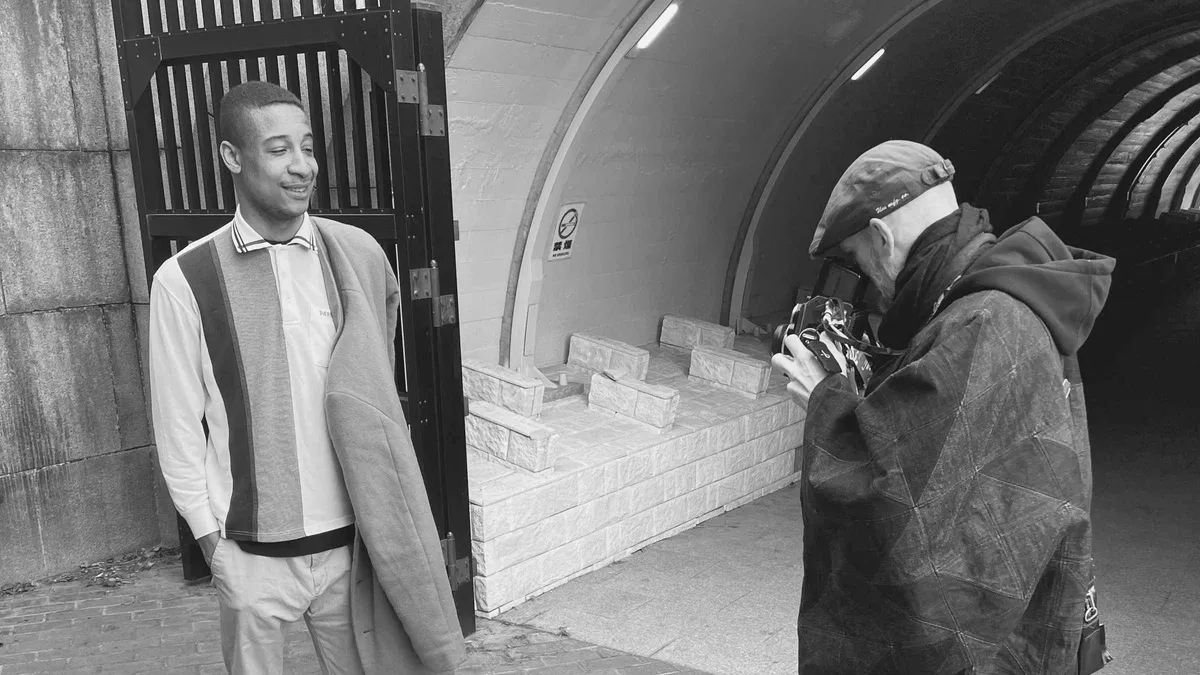
The practical half of the session. The instructor watches, the model takes direction, and the corrections happen while the picture is still fixable.
How the Ninety Minutes Run
-
Before you go
Pack the camera, charge everything
Bring a DSLR, mirrorless or film camera, plus comfortable shoes and a charged smartphone. Empty the memory card and charge the battery: a workshop that stops because the body is flat is an expensive way to learn that lesson.
-
Start
Meet at the Hachiko statue
The meeting point is directly in front of the Hachiko statue in Shibuya, which is busy, unmistakable and two minutes from the scramble crossing. Transportation fees are not included.
-
First stretch
The fundamentals
Camera settings, composition, what makes a portrait engaging, and how to work with the light you have rather than the light you wanted.
-
The practical
Photograph the model
A local freelance model poses while you shoot, and the instructor gives individual feedback as you go. Off-camera flash is practised here, with equipment provided.
-
Moving
Landmarks and side streets
The session covers well-known Tokyo locations and lesser-known ones, which is where the composition lessons get tested against real backgrounds and real crowds.
-
End
You leave with your own files
Nothing is delivered afterwards. What you shot is what you have, which is the point of paying to learn rather than paying to be photographed.
The Camera You Have to Bring
The kit list is short and one line of it is non-negotiable, so it is worth reading twice before booking.
A phone will not do the job here
The what-to-bring list names comfortable shoes, a camera and a charged smartphone. The know-before-you-go section then removes the ambiguity: bring a DSLR, mirrorless or film camera.
That is not snobbery. Half the syllabus is camera settings and off-camera flash, and neither is teachable on a device that hides its aperture and cannot trigger a strobe. The phone on the list is for communication and reference, not for the workshop itself. If you do not own an interchangeable-lens camera and are not planning to hire one, this is the wrong booking, and being photographed by somebody else is the right one.
Beginners genuinely are welcome
The listing states that beginners are welcome and that the workshop encourages questions and interaction, and the two-student cap makes that credible rather than aspirational. Owning a camera you do not understand is the normal starting point, not a disqualification.
What helps is arriving with the manual skimmed and the battery charged, so the first twenty minutes are not spent finding the aperture control. What also helps is deciding in advance what you want to leave with: a technique, a set of frames, or a decision about whether to buy a flash.
Where the price sits
At $50 per person for ninety minutes, this is the cheapest way to spend an hour and a half with a photography professional in this catalogue, and the only one where nobody photographs you. For context on the other side of the lens, the cheapest session with a professional shooting you is $35 per person for an hour in a small group of up to four, and the dearest is $233 per group of up to two for a cinematic shoot with fifteen fully retouched frames.
Read it against the wider workshop market rather than against the portrait sessions, though. The Tokyo photo-tour operators ranking for this search sell half-day and full-day programmes, and a name-brand street photography workshop is a multi-day commitment at a different price altogether. Ninety minutes with a hired model and a cap of two students is a sampler of that world at the cost of a decent dinner. Everything on this site, in both directions, is laid out in the comparison table.
Where You May Actually Shoot in Tokyo
Once you are the one holding the camera, the city's photography rules stop being trivia and start being your problem. Three of them catch visitors constantly, and none of them is signposted in English at the point it matters.
The two alleys that everyone photographs and should not
Omoide Yokocho, the lantern-lit lane by Shinjuku Station, is managed by a body that prohibits all photography and videography, creative or editorial, without prior permission. Approved shoots wear a shooting-approved armband and are chaperoned by staff. Golden Gai, the cluster of tiny bars nearby, prohibits photography and video without the approval of the district's business promotion association, and posts no-photo signs with a camera crossed out in red throughout the lanes. Its patrons come for the discretion, which is the actual reason for the rule.
Both appear in countless travel photographs and both are the sort of place where a stranger with a camera creates a problem rather than an image. If you want them, ask; do not assume.
Shinjuku Gyoen has written rules, and they are strict
The garden's own rules, published by the Ministry of the Environment, prohibit commercial photography inside it: promotional shoots, brochure and website photography, and photographing models in order to sell the images. Groups may not exceed 10 people including models. Hand-held equipment only, no light stands, no stepladders, no hand trucks. Tripods and reflectors are banned outright during peak periods such as cherry-blossom season, and revealing clothing, swimwear and cosplay are restricted.
That matters here because the garden is the first location several international photographer services list for Tokyo. Practising portraits with a model inside it is not a grey area if money changed hands for the model, and the group cap counts the model as a person.
What is genuinely open
Public streets are fine, and Tokyo has more of them than anywhere. The scramble crossing outside the meeting point, the Kabukicho main strip, the approach to Sensō-ji, and the Sumida riverside are all shot constantly and legally. What varies is courtesy: temples are working religious sites, Nakamise's stallholders are trading, and Kabukicho is somebody's workplace at midnight.
One local ordinance worth carrying: Shibuya has banned street drinking from 18:00 to 05:00 all year round around the station and Miyashita Park since 1 October 2024. Enforcement is by warning, but a drink in the frame after dark is a picture of a rule being broken. The districts, their hours and what each gives a camera are set out in the photo spot guide.
Tokyo Photography Workshop Questions
Do you need photography experience to join?
No. The listing states that beginners are welcome and that the workshop encourages questions and interaction, and with the group limited to 2 participants the instructor can pitch the session at whoever turns up. Arrive with the battery charged and the memory card empty and you will spend the time on photography rather than on setup.
How many students are in the group?
Two. The listing sells it as a small group limited to 2 participants, so at most one other student shares the instructor and the model with you. That cap is what makes the promise of individual feedback throughout the session credible at this price, and it is far smaller than the group sizes on the half-day and full-day photo tours that rank for the same search.
What camera do you need to bring?
A DSLR, mirrorless or film camera. The what-to-bring list also names comfortable shoes and a charged smartphone, but the phone is for communication, not for shooting. Half the syllabus is camera settings and off-camera flash, neither of which is teachable on a phone.
Is there really a model?
Yes. A local freelance model is hired for the session and poses for you on location while the instructor gives individual feedback. The listing adds that the model may sometimes be Japanese. No model release is mentioned anywhere, so ask before you publish the pictures commercially.
Do you need your own flash?
No. Off-camera flash technique is part of the workshop and the listing says you are welcome to join even if you don't own a flash. It is a useful ninety minutes for deciding whether buying one is worth it.
Where does it meet and how long does it run?
Directly in front of the Hachiko statue in Shibuya, for 1.5 hours. Transportation fees and food and drinks are not included, and start times appear at checkout. Free cancellation applies up to 24 hours before the session.
Do you get edited photos afterwards?
No, and that is the whole distinction. You keep the files you shoot yourself, and nothing is delivered later. If a finished gallery is what you actually want, the Kabukicho night session delivers 35+ edited photographs and the Asakusa temple session sells tiers of 20, 50 or 75.
How does it compare on price?
It is the cheapest ninety minutes with a professional on this site at $50 per person. Being photographed instead starts at $35 per person for an hour in a small group and runs to $233 per group of up to two for the cinematic option. The whole ladder is in the comparison table.
Are there reviews yet?
No. It is listed as a new activity with no reviews, and we have not borrowed anyone else's to fill the space. The specifics on the listing are checkable instead: two students maximum, a named syllabus, a hired model and a fixed meeting point.
Prices, availability and terms are set by the operator and confirmed at checkout.
We may earn a commission if you book through one of our links, at no extra cost to you. Full affiliate disclosure